Yamaha MT-09 vs Kawasaki Z900 (2025): power, weight and everyday compromises
Contents
The Kawasaki Z900 leads on engine capacity and peak output. The Yamaha MT-09 offers a lower published weight, another fork adjustment and separate settings for individual rider aids. The Kawasaki also carries more fuel. These differences reach beyond engine preference: they affect what you can adjust, what you move around the garage and how you plan a longer ride.
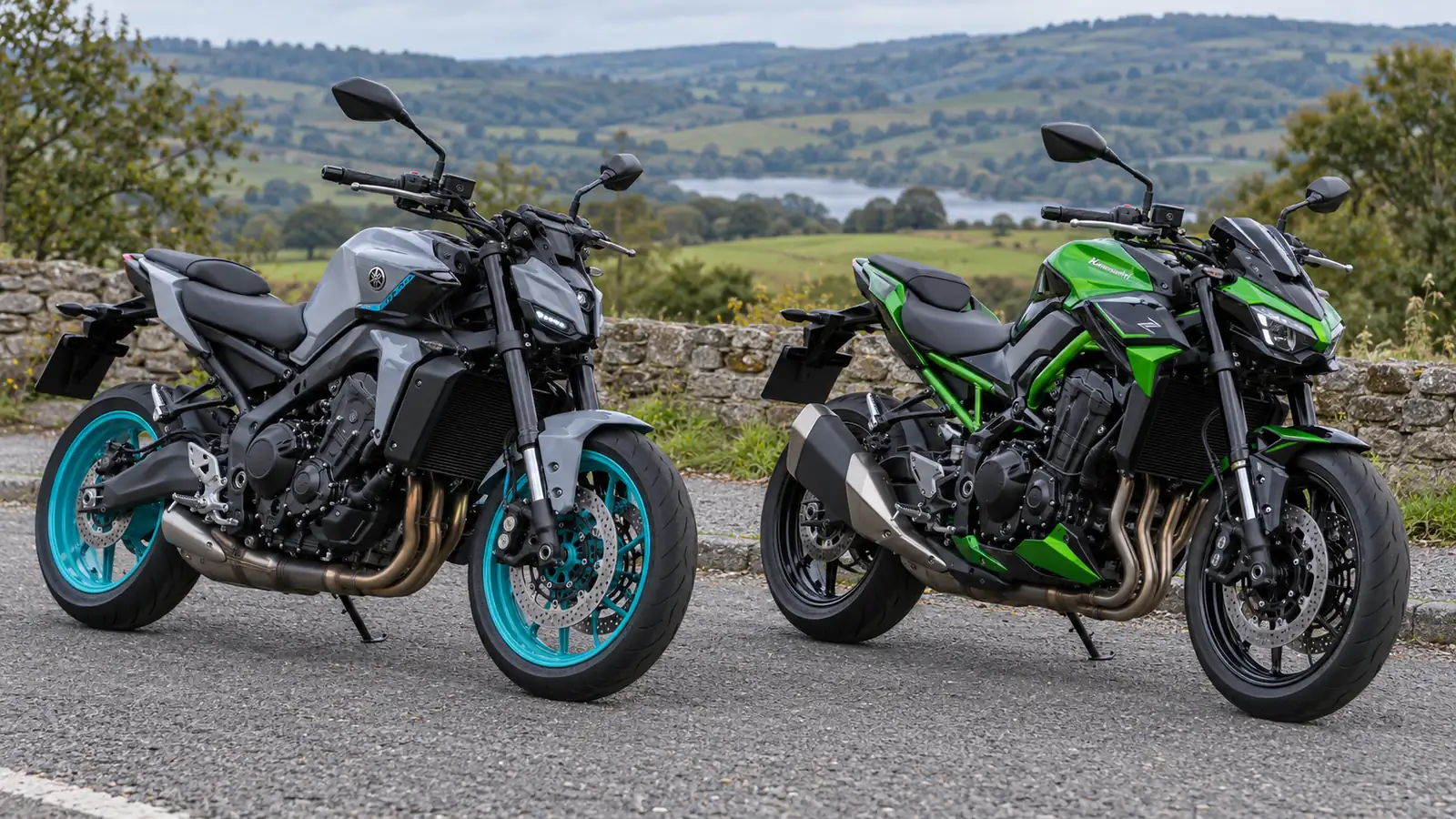
Standard, full-power European MY2025 models: manual MT-09, excluding SP and Y-AMT; Z900, excluding SE and Performance. This comparison uses specifications and separate road reports; Yamaha impressions concern the generation introduced for 2024. Only the top-speed figures refer to the named Y-AMT 2025 and SE 2026.
Yamaha MT-09 vs Kawasaki Z900 specs
| Specification | Yamaha MT-09 | Kawasaki Z900 |
|---|---|---|
| Engine | 890 cc inline-three | 948 cc inline-four |
| Peak power | 117.3 hp (87.5 kW) at 10,000 rpm | 122.0 hp (91.0 kW) at 9,500 rpm |
| Reported top speed (versions stated) | Approx. 230 km/h (Y-AMT 2025) | 228.4 km/h (SE 2026) |
| Peak torque | 93 Nm at 7,000 rpm | 97.4 Nm at 7,700 rpm |
| Published mass | 193 kg wet, including a full fuel tank and oil | 213 kg curb mass, with operating fluids and more than 90% fuel capacity |
| Nominal seat height | 825 mm | 830 mm |
| Fuel tank | 14 L | 17 L |
| Front fork | 41 mm inverted; preload, rebound and compression damping adjustment | 41 mm inverted; preload and rebound damping adjustment |
| Rear shock | Preload and rebound damping adjustment | Horizontal Back-link; preload and rebound damping adjustment |
The 20 kg difference is between manufacturer-published figures with different fuel definitions, not an identically fuelled weigh-in.
MT-09 vs Z900 top speed
Reported top speeds are approximately 230 km/h for the MT-09 Y-AMT 2025 and 228.4 km/h for the Z900 SE 2026. These are different versions in separate reports, so the figures do not establish which standard MY2025 bike is faster.
Engines: the power figures and the response behind them
The Z900 has 3.5 kW more peak power and 4.4 Nm more peak torque. Its torque maximum arrives higher in the rev range, too. Those are the headline differences; the road reports add useful context about the response below the peaks.
Tests of the 2024-generation MT-09 describe a responsive triple with useful pull without constantly chasing high revs. Reports of the 2025 Z900 describe progressive throttle response and accessible mid-range delivery. The Kawasaki's four-cylinder layout is no reason to assume it needs high revs for ordinary road riding.
On the test rides, pay attention to how each engine responds as you open the throttle at your usual pace. That is the part of the comparison the peak figures leave open.
Setup: what the MT-09 lets you change
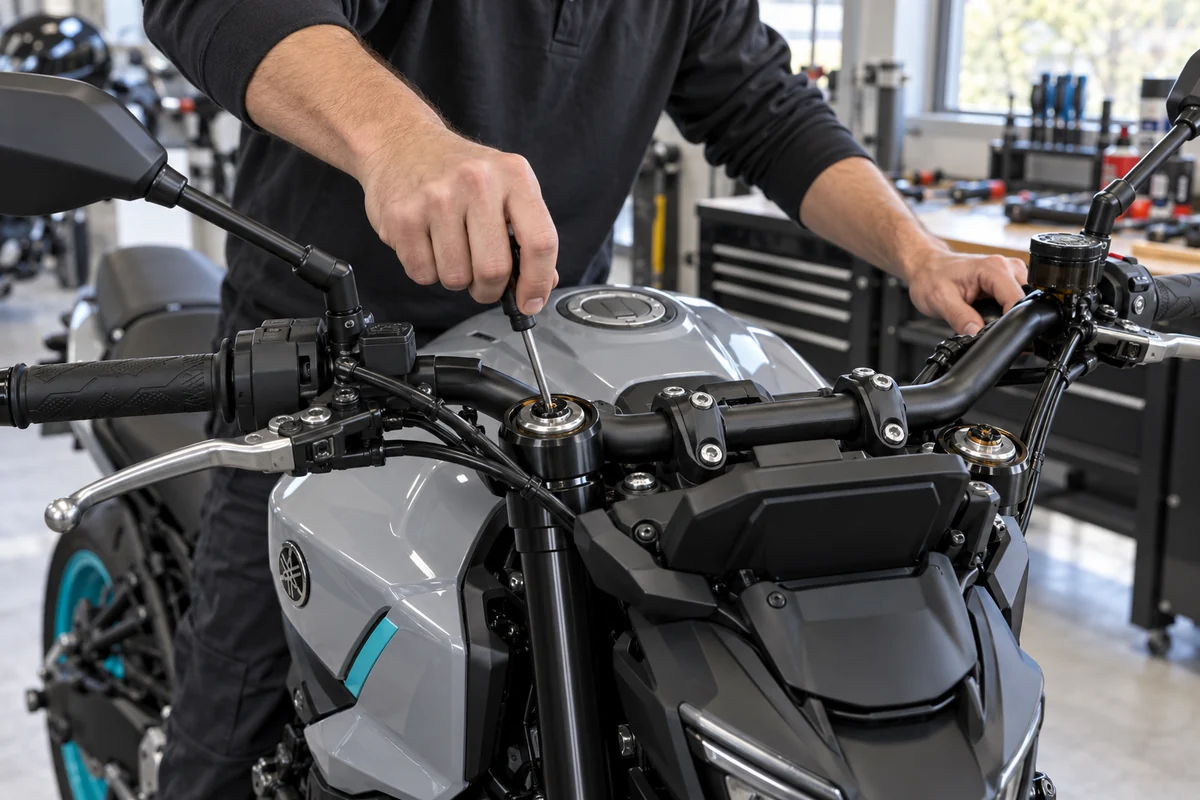
Both bikes offer fork preload and rebound adjustment; the standard MT-09 adds external compression adjustment. A rider or suspension specialist can therefore alter another aspect of the fork's response without replacing internal parts. Both rear shocks provide preload and rebound adjustment.
The extra fork control matters if you intend to use it as part of a setup. It gives the Yamaha more tuning scope, rather than proving that it rides better on its factory settings.
The electronic settings follow a similar pattern. Both have preset modes: Sport, Street and Rain on the Yamaha; Sport, Road and Rain on the Kawasaki. The MT-09's CUSTOM 1 and CUSTOM 2 modes provide separate power-delivery, traction, slide and front-wheel-lift settings. Brake Control has its own setting.
The Z900's Rider mode lets you select Full or Low power and a KTRC traction setting. KTRC also manages wheel lift. The distinction is Yamaha's explicitly separate controls, not an exclusive wheel-lift function. Cruise control, IMU-based rider aids and a 5-inch TFT are listed on both bikes.
Weight and fit: moving the bike with the engine off
If you regularly wheel a bike backwards into a tight space, the MT-09's lower published mass is a reason to try it first. Ask to move both bikes with the engine off during the dealer visit. It is a useful check alongside the usual sit on the saddle, especially if space at home is awkward.
The nominal seat heights differ by just 5 mm. Road reports describe the 2025 Z900's riding position as supportive, with room to move and relatively little wrist loading. Check the reach and your posture on both bikes rather than choosing from the seat-height figure alone.
Tank and range: the Kawasaki's practical advantage
The Z900 carries 17 litres against the MT-09's 14. Using the manufacturers' declared consumption figures of 4.8 and 5.0 L/100 km respectively gives theoretical full-capacity distances of approximately 354 km for the Kawasaki and 280 km for the Yamaha. The calculated difference is approximately 74 km.
The calculation ignores reserve, unusable fuel, weather, route and riding style. It is a planning comparison, not a distance to ride before refuelling. On routes with few fuel stops, the Z900's extra capacity is a concrete reason to put it first on the shortlist.
Verdict
For a rider who wants to tailor the bike, our choice is the MT-09. The extra fork adjustment and separate rider-aid settings are the deciding arguments. The lower published mass also warrants a closer look, with the smaller tank the compromise to accept.
For longer routes where fuel planning matters most, choose the Z900. Its additional capacity addresses that need directly. There is no need to make its small peak-power advantage the deciding factor.