Ténéré 700 vs Transalp 750: dirt routes or longer road trips?
Contents
The Yamaha Ténéré 700 gives you more ground clearance and more suspension adjustment. The Honda XL750 Transalp puts more power behind a lower seat, with a slightly larger fuel tank. Both have 21-inch front wheels. The useful distinction is what you want to do after the road ends, and how much road riding comes before it.
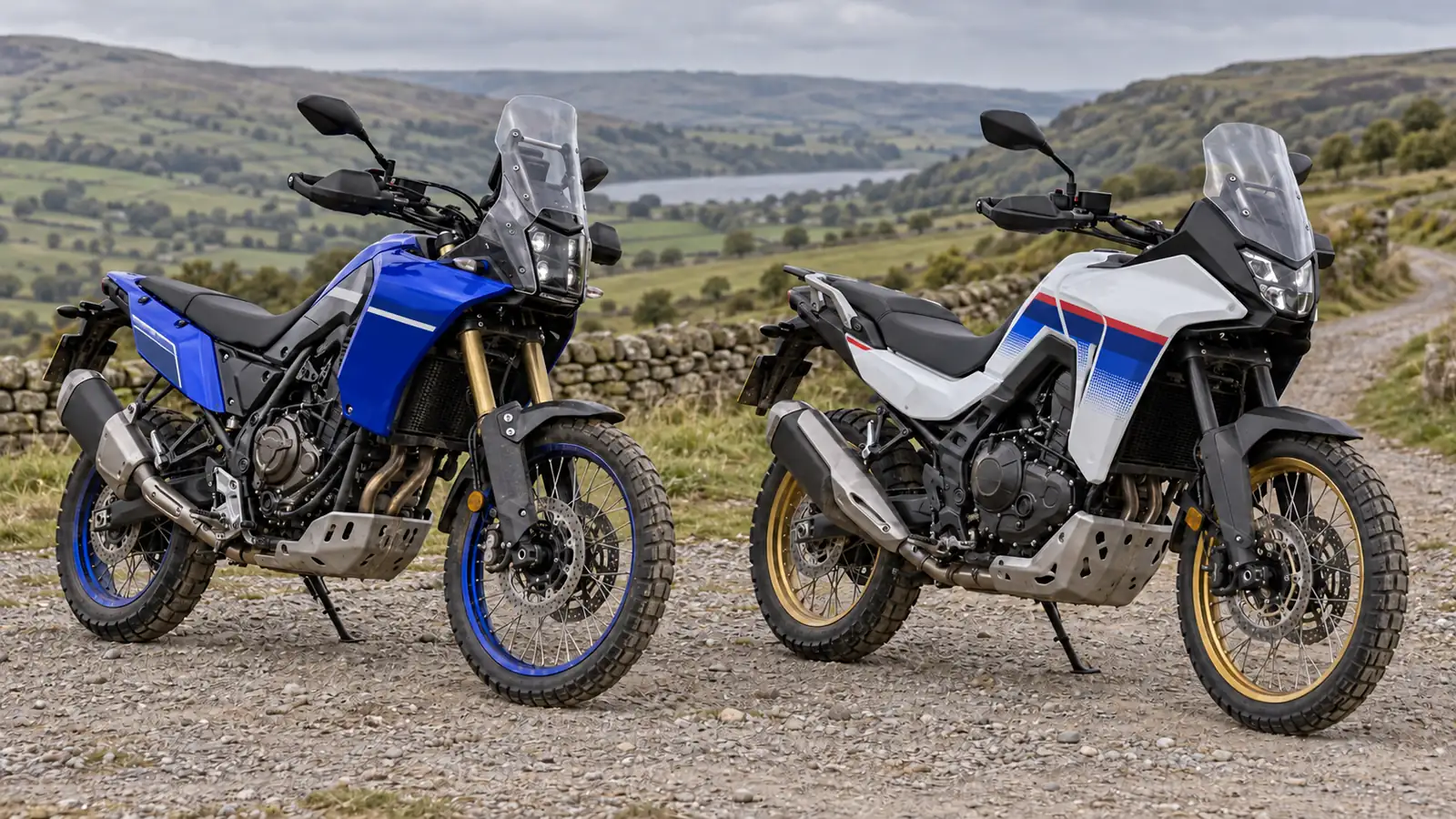
Standard, full-power European MY2025 models, excluding the Ténéré Rally and Low and the Transalp E-Clutch. This is a specification-led comparison with published riding observations, not our own back-to-back test. The reported top speeds below concern the separately identified versions.
Yamaha Ténéré 700 vs Honda Transalp 750 specs
| Specification | Yamaha Ténéré 700 | Honda XL750 Transalp |
|---|---|---|
| Engine | 689 cc parallel-twin | 755 cc parallel-twin |
| Peak power | 72.4 hp (54.0 kW) at 9,000 rpm | 90.5 hp (67.5 kW) at 9,500 rpm |
| Reported top speed | 183.6 km/h (Rally, 2025 test) | 195.6 km/h (2023 test) |
| Peak torque | 68 Nm at 6,500 rpm | 75 Nm at 7,250 rpm |
| Published mass | 208 kg wet, including full oil and fuel tank | 210 kg kerb |
| Seat height | 875 mm | 850 mm |
| Ground clearance | 240 mm | 210 mm |
| Suspension travel, front/rear | 210 / 200 mm | 200 / 190 mm |
| Suspension adjustment | Fork and shock: preload, compression and rebound | Fork and shock: preload |
| Wheels, front/rear | 21 / 18 inches, spoked | 21 / 18 inches, spoked |
| Fuel tank | 16 L | 16.9 L |
Mass figures retain each manufacturer's description; they are not an identically fuelled weigh-in.
Ténéré 700 vs Transalp 750 top speed
The reported top speeds are 183.6 km/h for the Ténéré 700 Rally and 195.6 km/h for the Transalp. The reported figures concern a Ténéré 700 Rally tested in 2025 and a Transalp tested as a 2023 model. They do not establish the top-speed difference between the standard MY2025 bikes.
Off-road: the Yamaha gives you more to work with
The Ténéré's advantage starts underneath the bike. It has 30 mm more nominal ground clearance, plus another 10 mm of suspension travel at each end. That is extra space beneath the chassis when a route becomes rocky or rutted, rather than simply a taller appearance.
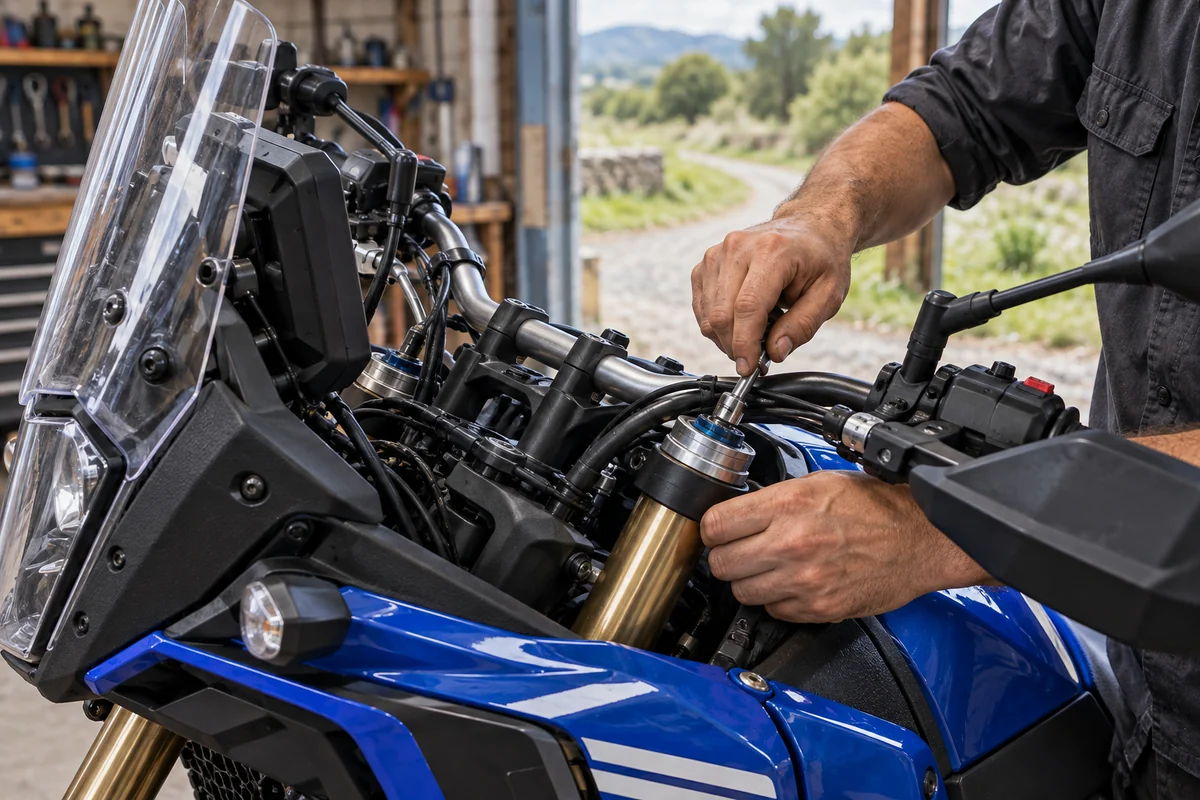
Its damping controls are the more substantial difference. You can adjust compression and rebound at both ends, alongside spring preload. The 2025 Transalp offers preload adjustment at the fork and shock, but not those external damping controls. If you intend to tune the suspension for rough routes and changing loads, the Yamaha gives you more scope before considering replacement components.
A published comparison of the updated 2025 models describes a more accommodating suspension response over pronounced bumps on the Ténéré, with room to move while riding standing up. The Transalp comes across as the more road-oriented option in that account. Both use the same front and rear wheel diameters, so choosing the Yamaha for dirt is about the whole chassis package, not an exclusive 21-inch front wheel.
Engines: more peak power does not settle low-speed riding
The Transalp has 13.5 kW more peak power and 7 Nm more peak torque. For a buyer who wants the stronger top end, that is a substantial reason to favour the Honda.
The riding comparison adds a distinction the totals miss: the Yamaha is described as responsive through the middle of the rev range, while the Honda's stronger upper-range delivery becomes more prominent as revs rise. A rider working through a loose, slow section is asking something different of the engine from a rider accelerating hard on an open road.
Neither 2025 bike is an electronics-free alternative. The Yamaha has Sport and Explorer throttle maps, switchable traction control and selectable ABS operation. The Honda provides preset riding modes and a configurable User mode, including engine-braking settings and rear ABS deactivation. At the dealer, ask to see how you change the road and off-road settings and which choices survive an ignition cycle.
Seat height and comfort: the Honda's stronger road argument
The Transalp's standard seat is 25 mm lower, a concrete difference for a shorter rider to check. Sit on both in riding boots and lift each off its stand with assistance from the dealer; seat shape and suspension compression still affect the reach to the ground.
The same comparison favours the Honda's seat comfort and describes less intrusive vibration than on the Yamaha. That matters on a journey with hours of tarmac before the interesting track begins. The Ténéré's taller stance and freedom to move make more sense when standing riding is a regular part of the day, rather than an occasional experiment.
Fuel stops: a modest advantage for the Transalp
Both manufacturers declare 4.3 L/100 km. Using the full nominal tank capacities gives theoretical distances of approximately 372 km for the Yamaha and 393 km for the Honda, a difference of about 21 km.
Those calculations ignore reserve, unusable fuel and changes in consumption with load, terrain and speed. The Transalp's extra capacity helps with planning, but it is a modest difference. It should not outweigh a seat or suspension package that suits your riding better.
Verdict
For a trip built around rough tracks, our choice is the Ténéré 700. Its clearance, suspension adjustment and standing-riding package address that job directly. Accept the taller seat as part of the decision, rather than assuming you will get used to it after buying.
For predominantly road travel with unpaved sections along the way, choose the Transalp 750. The lower standard seat, reported comfort and stronger top end make the more persuasive package for that use. Its smaller adjustment range is the compromise to consider if those unpaved sections become the main reason for the trip.